Sunday May 08, 2016
April 2016 Zazenkai Talk (TREELEAF'S 10th ANNIVERSARY!)
Zazenkai
Zazenkai


Sunday May 08, 2016
Sunday May 08, 2016
Today's Talk is dedicated to a fellow who historically got a bad rap. It is also shows how much our Shikantaza Zazen ways resonate with the Teachings of the ancient Masters in the earliest days of Zen ...
Heshang Moheyan (和尚摩訶衍)) was a late 8th century Chan monk (Chan is the Chinese name for Zen). He became famous for representing Chan in the so called "Council of Lhasa," a debate held in Tibet between adherents of the Indian teachings of "gradual enlightenment" and the Chinese teachings of "sudden enlightenment," which according to tradition was won by the "gradual teachings", causing Moheyan and all Chan Teachings to be expelled from Tibet. However, recent research has disclosed that the story is not so simple, and may represent a rewriting of history and what actually happened by those later advocating the esoteric teachings we now know as Tibetan Buddhism. It is now known that Moheyan and Chan Teachings were very influential and widely accepted in long ago Tibet for a long time before they were purged.
Further reading and discussion for this talk are available on the Treeleaf forum:May 6th-7th, 2016 - OUR MONTHLY 4-hour ZAZENKAI! »

Sunday Mar 27, 2016
Sunday Mar 27, 2016
Because “this place is where something ineffable exists,” it is through the realization of these words that Buddhist patriarchs are caused to be. And because the realization of these words of Buddhist patriarchs passes naturally from rightful successor to rightful successor, the skin, flesh, bones, and marrow, realized as “a whole body,” are “hanging in space.” This space is beyond such categories as the twenty kinds of space [such as inside, outside, over, below, etc.]. In general, how could space be limited to only twenty kinds of space. There are eighty-four thousand kinds of space, and there may be countless more besides.
Further reading and discussion for this talk are available on the Treeleaf forum:March 4th-5th, 2016 - OUR MONTHLY 4-hour ZAZENKAI! »
Thursday Feb 11, 2016
Thursday Feb 11, 2016
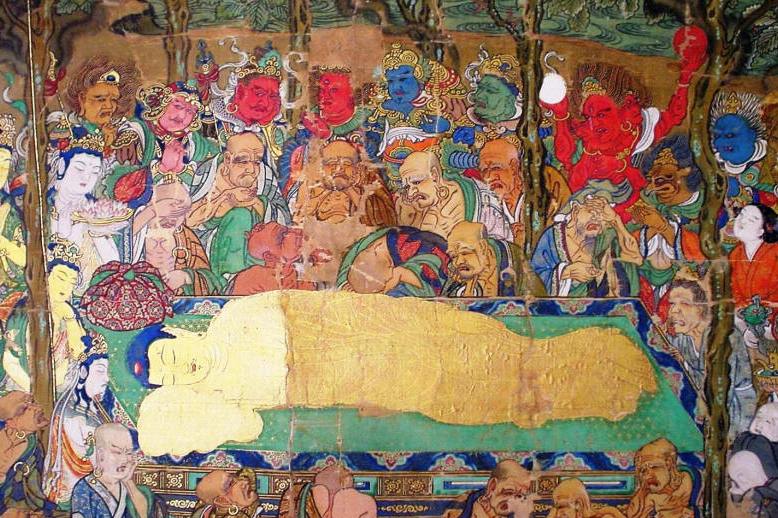
WELCOME to our Memorial & Celebration of NEHAN-E, (Pari-Nirvana) the traditional day to mark the historical Buddha's death and passing from this visible world. This is also a day for each of us to remember in our homes those family and friends who have gone before. As well, we particularly mark the passing of Nishijima Gudo Wafu and Rempo Niwa Zenji ...
Further reading and discussion for this talk are available on the Treeleaf forum:February 6th, 2016 - SPECIAL "NEHAN-E" 4-hour ZAZENKAI! »
Tuesday Jan 19, 2016
Tuesday Jan 19, 2016
To open this New Year, our reading will be the prologue to Master Dogen's Bendowa (On the Endeavor of the Way, Kaz Tanahashi Translation), written in 1231, one of the first pieces on Zen Practice written by Master Dogen following his return to Japan from China:www.lionsroar.com/just-wholeheartedly-sit
Further reading and discussion for this talk are available on the Treeleaf forum:January 1st-2nd, 2016 - OUR MONTHLY 4-hour ZAZENKAI! WELCOME THE NEW YEAR! »
Wednesday Nov 11, 2015
Wednesday Nov 11, 2015
For this talk, we will reflect on some of the Verses, Vows and Dedications
we are heard to Chant around here for each Zazenkai and at other times. For further reading on these and other Chants, I highly recommend
"Living by Vow: A Practical Introduction to Eight Essential Zen Chants
and Texts, by Shohaku Okumura, Wisdom Publications, 2012."Further reading and discussion for this talk are available on the Treeleaf forum:November 6th-7th, 2015 - OUR MONTHLY 4-hour ZAZENKAI! »
Saturday Oct 03, 2015
Saturday Oct 03, 2015
Reading: "Wild Ways of the Precepts in Japan"
It is not known if the precepts in sixteen articles resulted from
Dogen’s own innovation or if he borrowed this group from another source.
[Dogen, in a writing describing the ordination ceremony for his
priests] states that the ordination ceremony described therein is
exactly the same as the one conducted by [Dogen's Teacher in China]
Ju-ching in 1225 when he administered the precepts to Dogen. The
reliability of that assertion, however, seems doubtful. [from "Dogen and the Precepts" by Prof. Steven Heine]
Further reading and discussion for this talk are available on the Treeleaf forum:October 2nd-3rd, 2015 - OUR MONTHLY 4-hour ZAZENKAI! »
Tuesday Sep 08, 2015
Tuesday Sep 08, 2015
What is Ango in our day and time, for householders in the modern West? Is it Ango as the Buddha, Dogen and all the Ancestors Practiced?
The meaning of the Japanese word Ango [安居] (Skt : varsha or varshika; Pali: vassa ) is “tranquil dwelling”. The origin is the “rainy-season retreat” , the period when Buddhist monks in India stopped their travels and outdoor activities for the duration of the rainy season and gathered at some sheltered location to devote themselves to Practice, study and discipline. One practical reason was because the heavy rainfall made traveling and outdoor activities impractical. But it was also a time when the individual monks in Buddha’s time, spending most of the year scattered here and there in small groups or individually, could gather and unite as a community and Practice together. During the rainy season in India, monks traditionally dwelt in a cave or a monastery for three months—from the sixteenth day of the fourth month to the fifteenth day of the seventh month. During this period the monks learned the Buddha's teachings, engaged in meditation and other practices, and repented their harmful behavior and weaknesses. The tradition is said to have begun during the time of Shakyamuni, was brought to China, and in Japan the three-month retreat was first observed in 683. Now it comes to us.
Further reading and discussion for this talk are available on the Treeleaf forum:
September 4th-5th, 2015 - OUR MONTHLY 4-hour ZAZENKAI! ANGO SEASON BEGINS! »
Tuesday Aug 11, 2015
Tuesday Aug 11, 2015
Today's Talk:
Theory of Zazen for Three Personality Types
Sankon-Zazen-Setsu by Keizan Zenji
(translation by YASUDA & ANZAN, with some adjustments from Masunaga and Kennett)
In traditional Buddhist descriptions, there the three levels of capacity that Buddhist practitioners exhibit (sankon 三根; Sk. trīṇi indriyāṇi): dull (donkon 鈍根), middling (chūkon 中根; Sk. madhya indriya), and sharp (rikon 利根; Sk. tīskṣṇa indriya) capacities. These are three different capacities that Buddhist practitioners exhibit.
Dogenologist & Historian Carl Bielefeldt comments (Dogen’s Manuals of Zen Meditation, footnote 33 on p.152):
Here [in the “Theory of Zazen for Three Personality Types”] Keizan distinguishes three levels in the understanding of zazen (corresponding to the traditional Buddhist disciplines): the lowest emphasizes the ethical character of the practice; the middling, the psychological character; the highest, the philosophical. The second, he describes as ―abandoning the myriad affairs and halting the various involvements, ‖ making unflagging effort to concentrate on breathing or consider a koan, until one has gotten clear about the truth. (In the highest zazen, of course, this truth is already quite clear.) In his influential Zazen yojinki as well – though [Keizan] repeats the Fukan zazen gi passage on nonthinking—Keizan recommends the practice of kanna [Koan phrase centered Zazen] as an antidote to mental agitation in zazen (ibid. 497b).
Further reading for this talk is available in the Zazenkai forum thread:
August 2015 Zazenkai Forum Thread »