Monday Jul 18, 2011
SIT-A-LONG with Taigu: Okesa 2
TREELEAF ZENDO PODCAST
Dharma talks by Jundo Cohen Roshi & priests from Treeleaf Zendo
Listen on:




Episodes
Episodes


Saturday Jul 16, 2011
Saturday Jul 16, 2011
One thing my mother always used to tell me is "don't discuss religion with people, cause people get too easily defensive and offended about their personal religion.". It's true. Of course, that's a little hard to avoid when one is posting on an internet forum devoted to religion, Zen Buddhism in this case. People tend to take any criticism of their religion ... no matter how couched in "it's just my opinion", and no matter how small and reasonable the criticism ... as an affront. That's especially true when the critic is not an outsider, but someone inside the religion ... and maybe most especially clergy of the religion like Taigu and me.
This recently happened when I posted my last Sit-A-Long talk supportive of "out in the world" practice, and critical of some aspects (emphasis on "some aspects among many good points") of monastic practice entitled Knocking Down Monastery Walls, at ZFI, a sometimes surprisingly conservative place. People began to really jump on me and Taigu (who also added some comments very critical of monasteries and some of the institutionalized religion-ness that often accompanies them), accusing us sometimes as if we really wanted to rent bulldozers and do a sneak attack on helpless monks!
Taigu and I were taking our usual stand about how, for some or many folks (emphasis on "some or many" not "all"), training out in the world to be a priest might be a good path, and monastery life not possible or the wrong soil for that individual (emphasis on "for that individual"). The substance of the attitude of some folks can be symbolized by a typical post ...
There are many life situations which make someone not a proper candidate for ordination. Parents of small children, people in deep financial debt or legal difficulty, pregnant women, people in the armed forces... they have other obligations and are not proper candidates for ordination. They are also not proper candidates for the space program, a traveling circus, etc. This is not about "who is good enough." ... It's called home leaving.
To which I would typically respond with something like ...
Perchance, if one truly knows how to look ... some particularly wise folks can overturn the delusions of life right in the heart of life, shining in/as/right through life. Radical transformation can manifest where we stand. Buddhas can be seen in our small children, and freedom from the shackles of life are in the key of financial debt and legal difficulties. Pregnant women have Buddha Nature too (for one? for two?), and people in the armed forces serve in places where the "rubber meets the road" of the Precepts in action. Is not Enlightenment something even vaster than space, and is not life just a wondrous (sometimes beautiful, sometimes ugly) circus?
And again, my point is that monasteries may be right for some people, but wrong for other people. "Out in the world" training may be right for some people, but wrong for other people. To each his own, and many good paths up the mountain suited to different people and needs.
I also became a bit hot under the collar at one point in one post with one guy, but generally kept my cool. However, I did notice a tendency of folks in such religious discussions to completely ignore how a statement is couched and hear what they want to hear, a kind of Cognitive Dissonance. For example, I pull no punches in my criticisms of certain small aspects of Buddhism and Zen, calling them "superstitious" and the like, or "abusive". But I typically do it in the following way ... in effect, pulling my punches!
In my humble opinion, and that is all it is (for one man's "made up legends" is another man's "sacred stories" that he has full right to believe) ... Buddhism does, among the many many very good things, contain much "superstition, bull-crackers, hocus-pocus and made up legends, baseless claims, funny hats and dusty rituals, institutional church-iness" that we could often do without, in my limited view ... and some situations which, among the many good situations, are sometimes occaisionally abusive, disfunctional, even cult-like
... but which, I fully recognize and respect, may be very beautiful and precious to others, interpreted quite differently by them. Lovely, and many paths up the mountain for different folks (anyway, ultimately, what mountain?) We cherish and honor the right of such folks to practice their religion as they wish in their Sanghas ... just as we cherish and honor the right of Jews, Christians, Muslims, Scientologists, Hari Khrisna's, Atheists, Agnostics of all stripes to practice their beliefs as they wish ... and we will practice as we wish in our little Sangha.
... which some people seem to hear in their minds as ...
You think Zen is bullshit, monasteries are all abusive and Buddhism is like Scientology!
Oy vey.
I'll have more on this topic in a future post ... including how people became very upset when I once turned into Bro. Brad and typed "bullshit" instead of "bull crackers". That became a more important topic than the monasteries!
Saturday Jul 09, 2011
Saturday Jul 09, 2011
MAITREYA is said to be the future Buddha, the successor to the historic Śākyamuni Buddha. It's said that his 'coming' which will happen in a few thousand (or perhaps millions) of years. In the meantime, he awaits his return, residing in Tuṣita Heaven. Yes, there are some elements to Maitreya rather like the 'Second Coming' of Jesus. Maitreya is taken by some as something like a Buddhist Messiah.
He is often seen seated in a pose somewhat reminiscent of Rodan's "THE THINKER", but with softer shape and expression, sometimes tranquil and sometimes crying, contemplating the suffering of sentient beings. In fact, Maitreya's name may be derived from the Sanskrit word Maitri (Metta in Pali), 'loving-kindness'.
Sometimes he is seen in this form ...
... perhaps from after he let himself go. However, the origins of this popular "Laughing Buddha" are actually found a figure called Hotei from China, a jolly fat monk who happened to be a devotee of Maitreya, and whose image became mixed into the Maitreya legend over time. In any event, even if not really "Maitreya", the image is very popular in Chinese Buddhist temples ... and Chinese restaurants. One popular belief is that if one rubs his fat belly on the 1st day of the Lunar Year, it will bring forth wealth, good luck and prosperity.
(In my case, I typically think of the Laughing Buddha when I break my diet ... often at a Chinese restaurant.)
Maitreya was frequently taken as a cult symbol driving peasant rebellions and other mass movements for social change or revolution in China in centuries past.
In so many ways, Maitreya is simply a symbol of future hope and change.
Today’s Sit-A-Long video follows at this link. Remember: recording ends soon after the beginning bells; a sitting time of 15 to 35 minutes is recommended.
Visit the forum thread here!
var _gaq = _gaq || [];
_gaq.push(['_setAccount', 'UA-5334280-2']);
_gaq.push(['_trackPageview']);
(function() {
var ga = document.createElement('script'); ga.type = 'text/javascript'; ga.async = true;
ga.src = ('https:' == document.location.protocol ? 'https://ssl' : 'http://www') + '.google-analytics.com/ga.js';
var s = document.getElementsByTagName('script')[0]; s.parentNode.insertBefore(ga, s);
})();
Monday Jul 04, 2011
Monday Jul 04, 2011
A very short introduction to the study of the kesa that we are starting this summer:
Please visit the forum thread here!
Friday Jul 01, 2011
Friday Jul 01, 2011
I often feel that monastic practice is so "yesterday" ... so "13th Century".It's true, and in some very important ways, it may be time to knock down the monasteries, throwing their cloistered inhabitants into the streets!
For most of its history, lay practice has taken a back seat to the "real spiritual action" said to happen only among the ordained Sangha, usually behind monastery walls. However, this no longer need be the case.
I in no way intend to deny the beauty and power of the monastic path for those called that way. There are depths and lessons to be encountered and awakened to and lived in that simple life, in the silence, in the sincere effort and routine. So much of that may not be easily perceived in the noise and distraction of an "in the world" practice. (Although, in my view, stillness is stillness, and the very same stillness can be encountered "out in the world" with a bit of diligence and attention to day-to-day life). I do not in any way intend to discount the importance of monastic practice for some folks ... and at appropriate times and doses for all of us.
However, there is also a beauty and power in paths of practice outside monastery walls that may be unavailable to those within the walls, with lay practice having depths and opportunities for awakening all its own. There are aspects of an "in the world" practice that are denied to those following a monastic way. There are depths and lessons of practice that can be encountered and awakened to only out in the city streets, in our work places, families, raising kids. Where is the Dharma not present?
Lay practice now is not the same as lay practice has been in centuries past.
One vital reason for monasteries and the like ... from the earliest days of Buddhism ... was an absence of other chances for communication with teachers and fellow practitioners, and a lack of other means to encounter "live teachings". In other words, wandering ascetics walking hither and thither in the Buddha's time needed to gather during the rainy seasons to "touch base" and reconnect with the group after being on their own for weeks and months. In the middle ages in China and Japan, one could not easily encounter a Buddhist teacher, teachings and opportunities to practice without going to live full time in a monastery. This is just no longer the case. Members of our Treeleaf Sangha, for example, can have 24 hour contact, using modern means of communication, with teachers, teachings, sittings, robe sewing, Sutra and Text study, sharing with fellow practitioners times of sickness and health and smiles and tears, Samu, spiritual friendships, "sharp stones crashing into each other" ... much of which, until the current times, was denied to people outside monastery walls.
In some important ways, sincere lay practitioners today may enjoy better surrounding circumstances for practice than did the average monk in, for example, Dogen's day. Things in the "Golden Age" were not so golden as we too easily romanticize. Most monks back then were half-educated (even in Buddhism), semi-literate (or what passed for literacy in those times), superstition driven, narrow folks who may have understood less about the traditions and teachings they were following ... their history and meaning and depth ... than we now know. The conditions for practice within old temples and monasteries might have been less than ideal, many teachers less than ideal, despite our idealization of the old timers. Studying Sutras by smoky oil lamp, living one's days out in Japan or Tibet while having no real information grasp on China and India and the customs of prior centuries, living in a world of rumor and magic and misunderstanding (in which all kinds of myths and stories and superstitions were taken as explanations for how the world works), unable to access a modern Buddhist library, or to "Google" a reliable source (emphasis on making sure it is reliable however!) to check some point, or to ask a real expert outside one's limited circle, being beholden to only one teacher at a time (no matter how poor a teacher), with no knowledge of the human brain and some very important discoveries of science ... and after all that effort ... getting sick and dying at the age of 40 from some ordinary fever. (Can you even imagine trying to listen to Dogen Zenji recite "live" a Shobogenzo teaching from way across the room ... without a modern microphone and PA system and "Youtube" to let one replay it all? I suppose many never heard a word!)
The "Good Old Days" were not necessarily the "Good Old Days".
In contrast, in many ways, the average lay person practicing today has very many better circumstances for practice than those monks in 13th century Eihei-ji. For that reason, it is time to re-evaluate the place and power of lay practice. What was true in the cultures and times of ages past need not be true today!
Now, we need the monastic way ... and we need the "in the world way" ... supporting each other.
Yesterday, a fellow posted to our Sangha a comment that:
the austere training at Eihei-ji ... [may be] required in 'dropping off' body and mind. The effort required to ensure that this is complete, 'dropping off dropping off', is something I think we find difficult in our lives since we live in more comfortable times. Can it be truly 'realised' outside a monastic setting?
I responded:
I rather disagree.
There are hard swimmers and runners, who push themselves to the limit ...
There are swimmers or runners who go at an easy and balanced pace forward ...
There are those who float along or stand perfectly still to admire the scenery ...
... and in all cases, it is the same ocean or road ... and no place to go.
Some folks may benefit from a hard practice, getting the hell beat out of them ... pushed along by a tough coach like a marine in boot camp. They may need this for a bit of discipline or to tame the wild bull of the mind. And some may not, encountering the Dharma in silence and stillness.
However, the answer really is not dependent on how hard we work for it, like a dog chasing its own tail.
Today’s Sit-A-Long video follows at this link. It is a longer talk (about 30 minutes), part of our July Zazenkai. A short Zazen and Kinhin follow.
Visit the forum thread here!
Friday Jul 01, 2011
Friday Jul 01, 2011
Dear All,
PLEASE NOTE THAT WE HAVE MOVED OUR NETCAST FROM USTREAM to JUSTIN.TV! CLICK ON LINKS BELOW:
Please 'sit-a-long' with our MONTHLY 4-hour ZAZENKAI, netcast LIVE 8am to noon Japan time Saturday morning (that is New York 7pm to 11pm, Los Angeles 4pm to 8pm (Friday night), London midnight to 4am and Paris 1am to 5am (early Saturday morning)) ... and visible at the following link during those times ...
LIVE ZAZENKAI NETCAST at JUSTIN.TV:
REMEMBER TO CLICK ON "FULL SCREEN" VERSION!
http://www.justin.tv/treeleafzen
But FEAR NOT if not possible for you to join 'live' in your location at those times, as the entire sitting is recorded in 'REAL TIME' and available for full participation 'ON DEMAND' at ANY TIME after that, no different from the 'live' sitting . Just click then on the links below:
THE 'REAL TIME, ANY TIME' recorded version is divided into 3 parts as follows (click on the links) :
00:00 - 00:50 CEREMONY (HEART SUTRA / SANDOKAI IN ENGLISH) & ZAZEN
00:50 - 01:00 KINHIN
01:00 - 01:30 ZAZEN
01:30 - 01:50 KINHIN
ZAZENKAI PART I LINK:
TO BE POSTED HERE AFTER LIVE NETCAST
01:50 - 02:30 DHARMA TALK & ZAZEN
02:30 - 02:40 KINHIN
TALK & ZAZEN PART 2 LINK:
TO BE POSTED HERE AFTER LIVE NETCAST
02:40 - 03:15 ZAZEN
03:15 - 03:30 KINHIN
03:30 - 04:00 METTA CHANT & ZAZEN, VERSE OF ATONEMENT, FOUR VOWS, & CLOSING
ZAZENKAI PART 3 LINK:
TO BE POSTED HERE AFTER LIVE NETCAST
Our Zazenkai consists of our chanting the 'Heart Sutra' and the 'Identity of Relative and Absolute (Sandokai)' in English (please download our Chant Book at the link below), some full floor prostrations (please follow along with me ... or a simple Gassho can be substituted if you wish), a little talk by me ... and we close with the 'Metta Chant', followed at the end with the 'Verse of Atonement' and 'The Four Vows'. Oh, and lots and lots of Zazen and walkin' Kinhin in between!
Please download and print out the Chant Book (PDF) at the following link:
viewtopic.php?f=11&t=2231
I STRONGLY SUGGEST THAT YOU POSITION YOUR ZAFU ON THE FLOOR IN A PLACE WHERE YOU ARE NOT STARING DIRECTLY AT THE COMPUTER SCREEN, BUT CAN GLANCE OVER AND SEE THE SCREEN WHEN NECESSARY. YOUR ZAFU SHOULD ALSO BE IN A POSITION WHERE YOU CAN SEE THE COMPUTER SCREEN WHILE STANDING IN FRONT OF THE ZAFU FOR THE CEREMONIES, AND HAVE ROOM FOR BOWING AND KINHIN.
ALSO, REMEMBER TO SET YOUR COMPUTER (& SCREEN SAVER) SO THAT IT DOES NOT SHUT OFF DURING THE 4 HOURS.
I hope you will join us ... an open Zafu is waiting. When we drop all thought of 'here' 'there' 'now' 'then' ... we are sitting all together!
Gassho, Jundo
Saturday Jun 18, 2011
Saturday Jun 18, 2011
Today's sitting is DEDICATED TO THE MEMORY OF CHARLOTTE JOKO BECK, who left our visible world this week, and whose ways (and books such as 'Everyday Zen' and 'Nothing Special' ... the titles say it all) have been so important to so many of us.
A couple of quotes:
"Life always gives us
exactly the teacher we need
at every moment.
This includes every mosquito,
every misfortune,
every red light,
every traffic jam,
every obnoxious supervisor (or employee),
every illness, every loss,
every moment of joy or depression,
every addiction,
every piece of garbage,
every breath.
Every moment is the guru."
Zen practice isn’t about a special place or a special peace, or something other than being with our life just as it is. It’s one of the hardest things for people to get: that my very difficulties in this very moment are the perfection...When we are attached to the.way we think we should be or the way we think anyone else should be, we can have very little appreciation of life as it is...whether or not we commit physical suicide, if our attachment to our dream remains unquestioned and untouched, we are killing ourselves, because our true life goes by almost unnoticed.
Today’s Sit-A-Long video follows at this link. Remember: recording ends soon after the beginning bells; a sitting time of 15 to 35 minutes is recommended.
Monday Jun 13, 2011
Sunday Jun 05, 2011
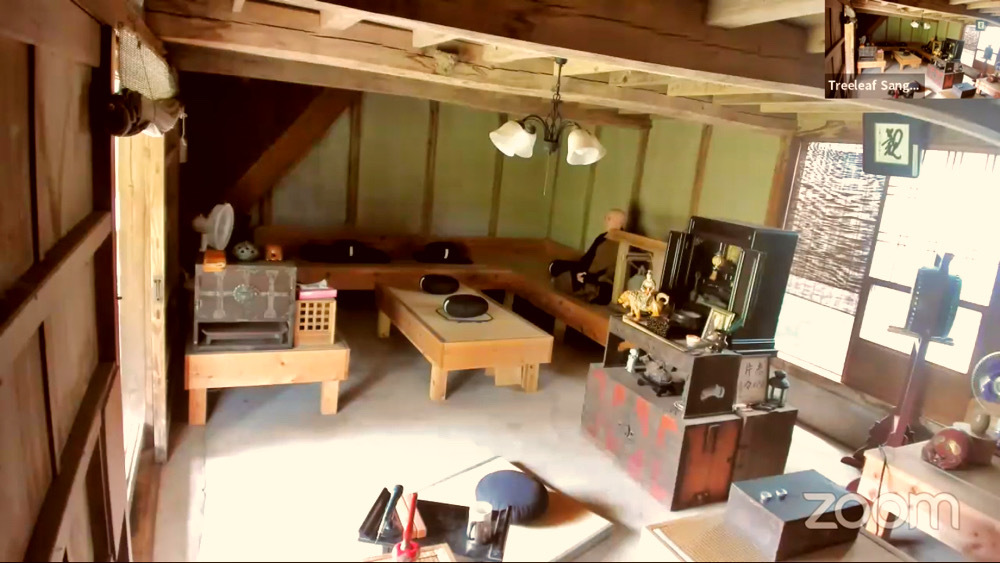
Welcome to Treeleaf Sangha
Treeleaf Zendo is an all-digital practice place for Zen practitioners who cannot easily commute to a Zen Center due to health concerns, living in remote areas, or childcare, work and family needs, and seeks to provide Zazen sittings, retreats, discussion, interaction with a teacher, and all other activities of a Soto Zen Buddhist Sangha.
Available for you any time, all fully online.